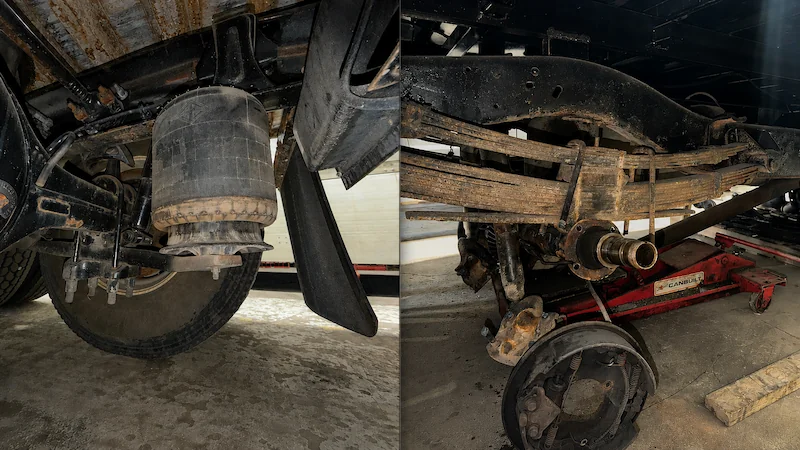
Choosing between air suspension and leaf springs depends on several factors, including load capacity, towing capacity, comfort, and the operating environment, as well as maintenance costs. Therefore, each system works best in its specific scenarios.
Leaf springs are ideal for vehicles used for hauling or carrying heavy equipment. They offer greater mechanical strength, require little maintenance, and cost less to operate. Air suspension on the other hand provides a smoother ride, adjustable ride height, and automatic load leveling, making it a better choice for protecting cargo and improving driver comfort.
There’s also a third option called a hybrid setup. It keeps factory leaf springs and adds air bags for adjustable support, providing some benefits of air suspension without requiring major chassis modifications.
In this article, we’ll compare all these three options in details, so by the end you’ll know which one makes sense for your loads, your routes, and your budget.
Air ride Vs Leaf Springs, How each system works
Air suspension and leaf spring suspension support vehicle weight in different ways. Leaf springs use stacked steel leaves to carry load through mechanical flex, while air suspension uses pressurized rubber air springs, valves, sensors, and an onboard air compressor to adjust ride height and spring force.
These differences make each suspension option more appropriate for specific vehicles and conditions. The choice between air suspension and leaf springs depends on the desired balance of comfort, control, payload, towing capacity, cost, and maintenance.
Leaf spring suspension
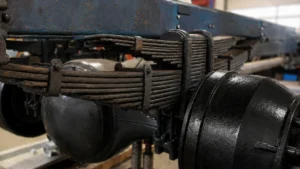
A leaf spring is a simple suspension option, which uses a stack of steel leaves bent in an arc shape to hold the weight of the vehicle. The leaves are placed one on another and attached to the chassis and axle with hangers, shackles, U-bolts, bushings, and axle seats. Most commercial vehicles use a semi-elliptical leaf spring design.
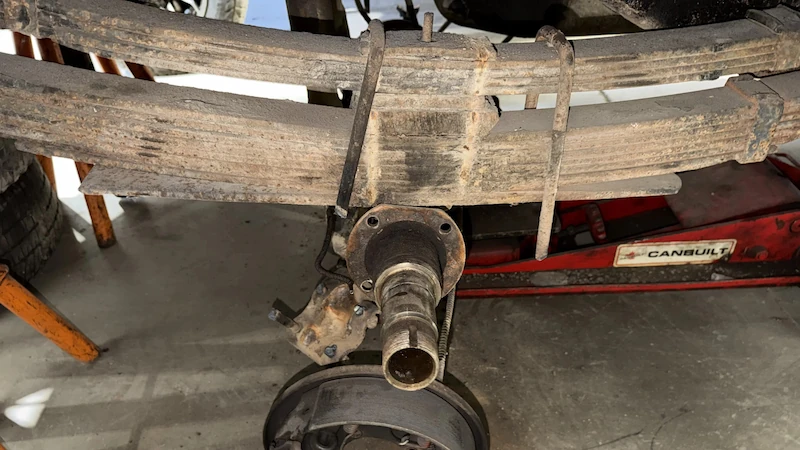
When the truck hits a bump or carries weight, the stacked leaves flex under force and return to shape as the load decreases. The spring arc and friction between the leaves absorb road impact and support payload weight. The system requires no air lines, valves, sensors, compressors, or electronic controls.
The leaf spring suspension is best suited for vehicles that carry heavy and consistent loads. It is used in dump trucks, service bodies, aggregate haulers, logging trucks, vans, trailers, pickups, and off-road vehicles. Leaf spring suspension is popular among commercial truck owners because of its good payload capacity, towing power, reliability and low maintenance costs.
The main advantages of leaf spring suspension are as follows:
- Carrying heavy loads with layered steel spring leaves
- Locating the axle with a simple mechanical structure
- Resisting bending through stacked spring layers
- Controlling axle movement with shackles and bushings
- Reducing system complexity through fewer moving components

Air ride suspension
Air suspension typically consists of rubber air bags (also called as air springs or air bellows) that carry the weight of the vehicle on a bed of pressurized air. A compressor, reservoir, air lines, valves, and height sensors make up the rest of the setup, which regulates pressure to keep the springs at a constant stiffness and height despite the load they are carrying
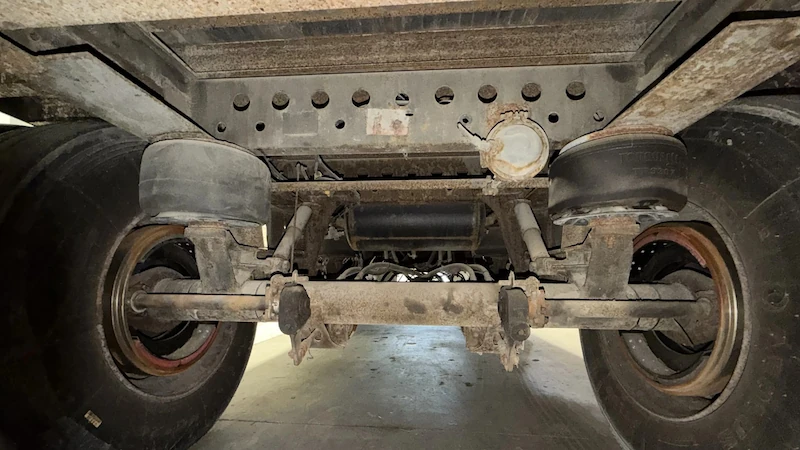
On many heavy-duty trucks and commercial vehicles, the suspension system is using the same air supply as brakes which allows them to control the amount of pressure in the bags by raising or lowering the chassis
The key feature of an air suspension is the ability to adjust the pressure in the bags, allowing them to carry significantly different weights while maintaining driver comfort. Air suspension also allows for keeping the vehicle’s body parallel to the road and makes the off-road or highway driving easier. Such technology can be found on luxury vehicles, SUVs, motorhomes, buses, commercial trucks, semi-trailer trucks, and modified cars. The functions include:
- Supporting weight with rubber air springs
- Adjusting pressure with an onboard compressor
- Controlling ride height with height sensors
- Moving air through valves, reservoirs, and air lines
- Improving comfort through variable spring force
Air Suspension vs Leaf Spring, Key Differences at a Glance
The key difference between the two systems is in the ability to adjust. The air suspension allows for fine-tuning by adjusting pressure and height based on the weight, while leaf springs utilize the metal’s elasticity to bear the load.
The empty or unloaded ride is what makes the leaf spring stand out, usually in a negative way. Most often, the leaf spring was built to carry rather than to drive, and you’ll feel the difference on every mile. A truck or a trailer that regularly deadheads empty 40% of the time stands to lose much in terms of practical performance compared to an air-suspended vehicle.
By contrast, the air suspension maintains optimal pressure, distributing the load between the two axles, including the drive axle, so as to maintain control at all times across varying levels of load. This is especially useful for line hauls, general freight transportation, or any commercial operation that uses temperature-controlled equipment, transport high-value cargo, or make long-haul trips.
| Features | Leaf Spring | Air Suspension |
|---|---|---|
| Ride comfort loaded | Good | Excellent |
| Ride comfort empty | Rough | Smooth |
| Load capacity | Excellent | Very good |
| Upfront cost | Lower | Higher, often about $1000 to $2000 more on new trailers |
| Maintenance | Low: mainly visual checks | Moderate: bags, lines, valves, sensors |
| Cold-weather performance | Reliable | Vulnerable if moisture freezes in lines |
| Adjustability | Fixed | Fully adjustable |
| Best use case | Heavy, consistent loads | Variable loads and sensitive cargo |
Cold weather changes the calculation in Canada. Air suspension can work well in winter, but it needs clean, dry air. Moisture in air lines can freeze, fittings can leak, and rubber air bags can crack faster after years of salt, cold, and road spray.
The Hybrid Option Nobody Talks About
Many North American pickups and light commercial trucks use a mixed set up with factory original leaf springs and aftermarket airbags installed on top of the axle. The air bags don’t replace the springs but rather support them, when the truck is towing, or hauling uneven weight.
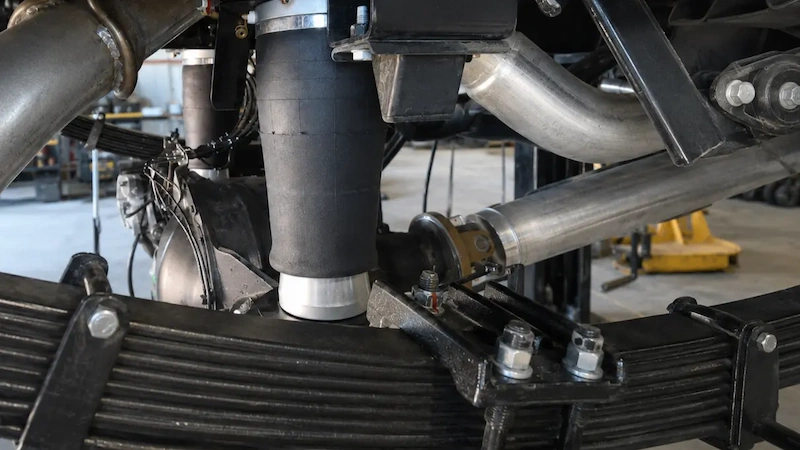
This setup is often the best option for pickups, cube vans, service trucks, motorhomes, and light commercial vehicles that carry heavy payloads occasionally. For example, someone who uses their truck for daily commuting and only tows their fifth-wheel camper on weekends will rarely need the extra lifting capability air suspension provides. At the same time, they will still benefit from the improved stability over uneven terrain, reduced sway, and decreased rear-end sag compared to leaf springs alone.
Compared to factory airbags, Air Lift and other manufacturers offer a broad range of bolt-on air bag helper kits suited to various popular pickups and light commercial trucks, with most costing between C$300 and C$600 for parts, depending on the model. Larger commercial vehicles typically rely on OEM equipment when choosing between the two options, with the decision based on whether they need a suspension with springs or airbags.
Air Suspension vs Leaf Springs for Ride Comfort
The air springs absorb small road impacts better and adapt to changing vehicle weight, so air suspension usually gives better ride comfort than leaf suspension. it is a better choice for long highway routes, empty return trips, premium SUVs, motorhomes, and freight that needs vibration control. Leaf suspension often feels firm when the vehicle is empty. The steel spring pack must carry heavy loads, which makes the unloaded ride stiffer.
| Driving condition | Better system | Reason |
|---|---|---|
| Empty pickup driving | Air suspension | Softer response |
| Highway cruising | Air suspension | Better isolation |
| Constant cargo load | Leaf suspension | Stable support |
| Mixed passenger and cargo use | Air suspension | Load-sensitive adjustment |
| Rough worksite driving | Leaf suspension | Strong mechanical durability |

Air Suspension vs Leaf Springs on Heavy Loads
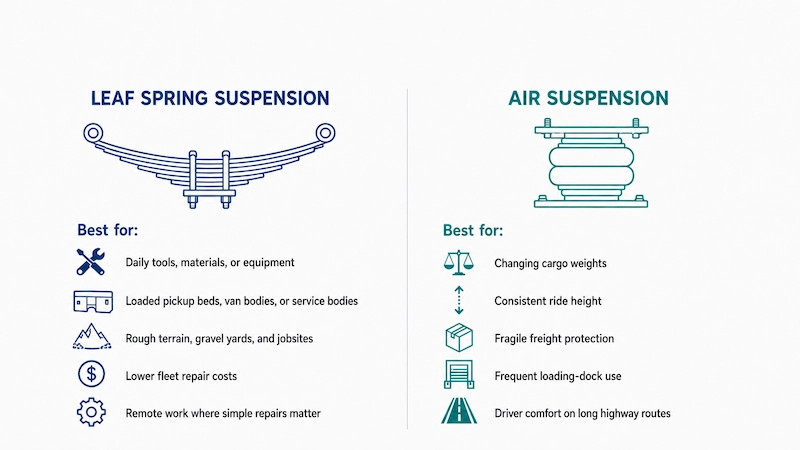
Both types of suspensions have the capability to withstand heavy loads if used in the right specifications; however, both depend on the workload of the vehicle. Leaf springs work best under heavy duty and harsh conditions, whereas air suspension works better where the load and the ride vary from trip to trip. The infographic below compares the operating conditions where each system performs best.
Which Suspension Is Better for Towing?
Generally, leaf spring suspension is strong for towing. Leaf springs manage tongue weight well because the rear spring pack provides direct mechanical support. Air suspension reduces rear-end sag when the system has enough capacity and is properly maintained. So, its better for load leveling during towing.
For many pickups, the strongest towing setup uses factory leaf springs with air helper bags. The leaf springs carry the main load. The helper bags add air pressure when the trailer pushes the rear axle down.
| Towing need | Best choice | Why it works |
|---|---|---|
| Heavy trailer with regular use | Leaf suspension | Strong rear axle support |
| Caravan with rear sag | Leaf springs plus air helper bags | Better ride height |
| Luxury SUV towing | Air suspension | Automatic leveling |
| Work trailer towing | Leaf suspension | Lower service cost |
| Mixed towing and daily driving | Air suspension | Better comfort balance |
A towing setup should always stay within the vehicle’s official ratings. Suspension upgrades can improve control, stance, and stability, but they do not override GVWR, GAWR, hitch rating, tire capacity, or brake limits.
What Is the Difference Between Full Air Suspension and Air Helper Bags?
Full air suspension uses air bags as the vehicle’s main springs. Air helper bags work alongside the existing leaf or coil springs to provide additional support. Helper bags can reduce rear-end sag and help keep the vehicle level, but they do not increase its legal payload rating. That rating is still limited by the chassis, axle, brakes, tires, and manufacturer specifications.
| System | Function | Common use |
|---|---|---|
| Full air suspension | Carries the vehicle through air springs | Luxury SUV, bus, truck |
| Air helper bags | Add support to leaf springs | Pickup, van, motorhome |
| Load-leveling kit | Corrects rear-end sag | Camper or towing setup |
| Aftermarket air kit | Improves height control | Modified truck or van |
Maintenance and Long-Term Costs
Leaf Spring inspections should be carried out every 25000 km or at least once a year, while checking U-bolt torque, leaves’ cracks, leaves shifting, bushing’s wear, damaged hangers, and loose shackles. The leaf spring pack is known to last 7-10 years on average with proper maintenance and not under extreme usage.
Air suspension requires more maintenance than leaf springs. Checking of air bags for any signs of cracking, dry rot, rubbing, and bag abrasion, and inspection of bags and lines for leaks are some maintenance tasks required for air bags. Height control valve performance also should be checked periodically. While in commercial use, bags may begin to fail earlier, and top-tier air bags may have a mileage of 7-8 years.
For Canadian climate, the winterization of fleets should be considered as a part of the maintenance schedule. Installing moisture separators, servicing air dryers, and using line antifreeze where possible will reduce cold-weather breakdowns. Over a ten-year span, with leaf springs being simpler and having a lower cost of ownership, they will appear to be the better option. Still, the total cost of ownership (TCO) of air-ride suspensions may balance the scale if there is a valuable cargo to be protected, improved driver comfort, and the shipper’s requirements.
Which Suspension Is Better Off-Road?
Leaf suspension is generally better for off-road due to the reduced number of components and its ability to withstand impact forces. It also ensures good performance on rough terrain making it ideal for commercial trucks, work vehicles, and off-road utility pickups.
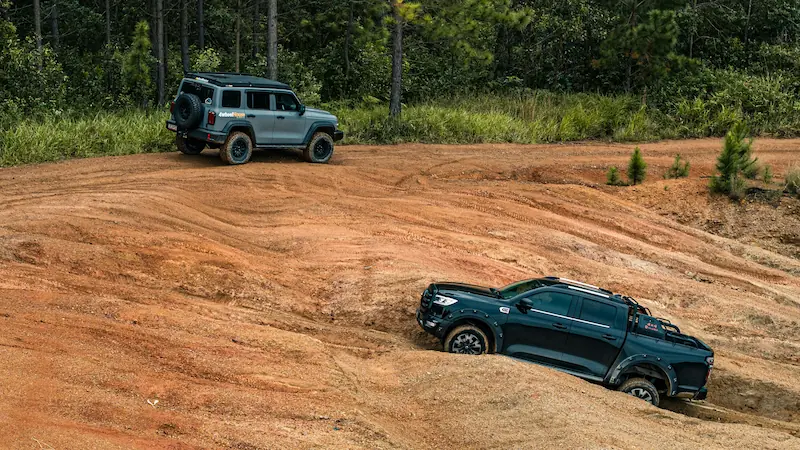
On the other hand, air suspension is beneficial in situations when the ability to adjust the ground clearance is required. This type of suspension can be seen on premium SUVs that provide the best off-road capabilities on rocky surfaces, deep mud, ruts, and through waterlogs. It should also be noted that a broken air suspension or a faulty air compressor can lead to the loss of some of the vehicle’s ground clearance abilities leaving the vehicle undrivable.

Which Suspension Is Better for Motorhomes?
Air suspension is often better for comfort and leveling in a motorhome, while leaf suspension is more suited to carrying a load. Motorhomes tend to carry a permanent load that includes the weight of the cabinets, water tanks, batteries, appliances, and personal belongings. Sagging at the rear is common when the motorhome’s rear axles bear too much of the load.
| Motorhome issue | Suitable solution |
|---|---|
| Rear sag | Air helper bags |
| Harsh ride | Full air suspension |
| Uneven side-to-side height | Adjustable air support |
| Heavy rear storage | Stronger leaf springs |
| Highway comfort need | Air suspension |
Air Ride vs Spring Ride on Trucks and Trailers
The buyer of a truck usually compares air suspension and leaf springs, while the trailer buyer studies air ride versus spring ride. Trailers equipped with air ride are perfect for mixed traffic, transporting light cargo, making frequent trips without a load, and stopping at a dock. However, trailers with spring rides are highly efficient for transporting heavy loads, operating on rough terrain, and having a lower upfront price.
Apart from suspension, slides tandems, and bogie configuration, the trailer can affect the ride. Moreover, these elements influence the load on axles, the ease of docking, and wheel alignment issues that show up as uneven tire wear, which implies that suspension is not the sole criterion to consider.
Getting the Setup Right Is Only Half the Job
Whatever suspension your truck or trailer uses, it still needs to be in good condition to do its job. Cracked leaves, worn bushings, leaking air bags, and faulty height-control parts can lead to poor handling, uneven tire wear, and unnecessary downtime.

Frequently Asked Questions
Yes, when the truck hauls variable or sensitive cargo over long distances. Air ride gives better comfort, cargo protection, and leveling. For steady heavy loads, leaf springs remain the better value.
Both can last the life of the truck with proper maintenance. Leaf springs usually last longer under extreme load and rough-site use. Air bags often last 7 to 10 years in commercial work.
Yes. Pickup trucks and light-duty commercial trucks can often use bolt-on air bag helper kits. Full commercial truck or trailer conversions cost much more because they can involve the axle, suspension assembly, ride height, and alignment.
Yes, if the air system stays dry and well maintained. Moisture in air lines creates the biggest winter problem. Air dryers, moisture separators, annual line inspections, and regular fitting checks prevent most cold-weather failures.
Yes, as long as the truck stays within its legal payload rating. Air suspension does not raise the truck’s weight rating by itself. It helps manage changing loads, level the truck, protect cargo, and improve control.
Air ride trailers use pressurized air bags to cushion the trailer and adjust to load changes. Spring ride trailers use steel spring packs. Air ride gives a smoother ride and better cargo protection. Spring ride costs less and keeps maintenance simpler.