A truck with an alignment issue will usually give warning signs before it becomes a costly repair. The truck starts to pull, the steering wheel sits off-center, or the steer tires begin wearing unevenly, long before anyone calls it a major problem.
Even one misaligned steer tire can start wearing unevenly within 15,000 km, long before it should. A good truck tire should last between 100,000 and 160,000 km. Misalignment can cut that short fast. To put it simply, a one-degree misalignment is like dragging your tire 17.5 meters to the side for every kilometer you drive.
Good steer tires are not cheap, and misalignment eats through that investment fast. It also forces the engine to work harder, which hurts fuel economy on every run. On wet roads, misaligned wheels reduce tire contact with the surface, increasing the risk of a blowout. And the constant stress does not stop at the tires. Ball joints, tie rods, and shocks all take a beating, too, adding more repair costs down the line.
The good news is that most alignment problems leave clues, and a major part of them can be detected during an inspection of the tires, a quick driving test, or even a steering test prior to making an appointment for servicing.
This guide explains the common signs of bad truck wheel alignment, what causes those problems, and when it’s time to book a professional alignment inspection.
Why Wheel Alignment Matters More on Trucks
Wheel alignment isn’t just about driving down the road with the steering wheel straight. For commercial vehicles, proper wheel alignment is a crucial maintenance factor. Heavy-duty trucks carry heavy loads, travel long distances, and take hard hits from potholes, road crowns, loading docks, and uneven job-site surfaces.
Wheel alignment shifts cause truck tires to run crooked. They start to scrub against the road, create heat, drag, and put excessive stress on suspension parts.
For fleets, the problem can quickly turn into a serious issue. One truck with alignment issues is bad enough, but 10 trucks with the same problem can quickly turn into a serious money pit, with high tire and fuel costs before the real problem is identified.
The Three Alignment Angles: What Goes Wrong and Why
Every truck alignment check looks at three main angles. Each one affects the way the tires meet the road.
| Alignment angle | What it controls | Common problem | The wear pattern causes |
|---|---|---|---|
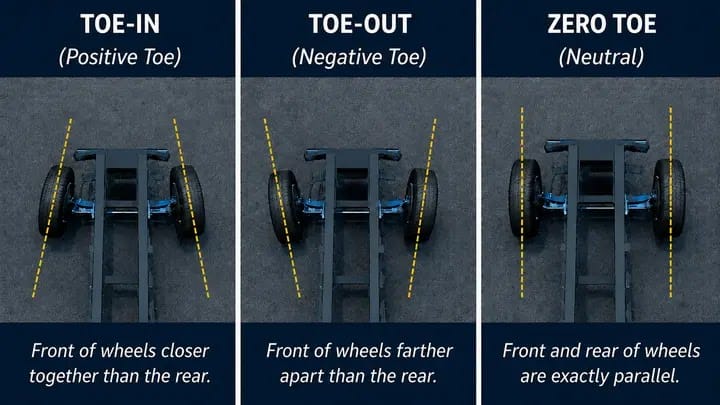
| Toe | Whether tires point inward or outward when viewed from above | Toe in or toe out caused by road impacts or worn tie rods | Feathering, where the tread feels sharp one way and smooth the other |
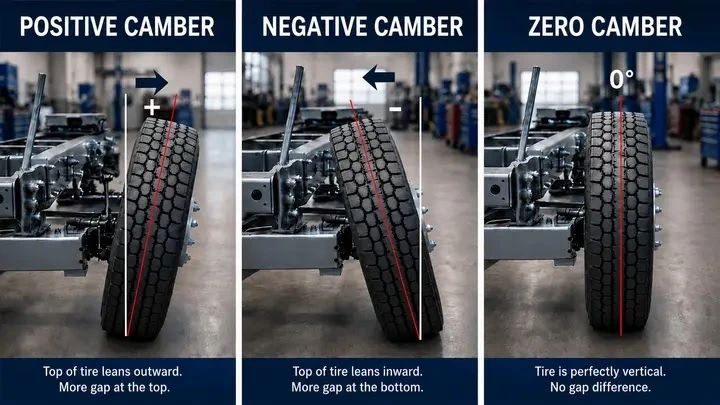
| Camber | The tilt of the tire when viewed from the front | Positive camber, where the top leans out, or negative camber, where the top leans in | Outer shoulder wear with positive camber, inner shoulder wear with negative camber |
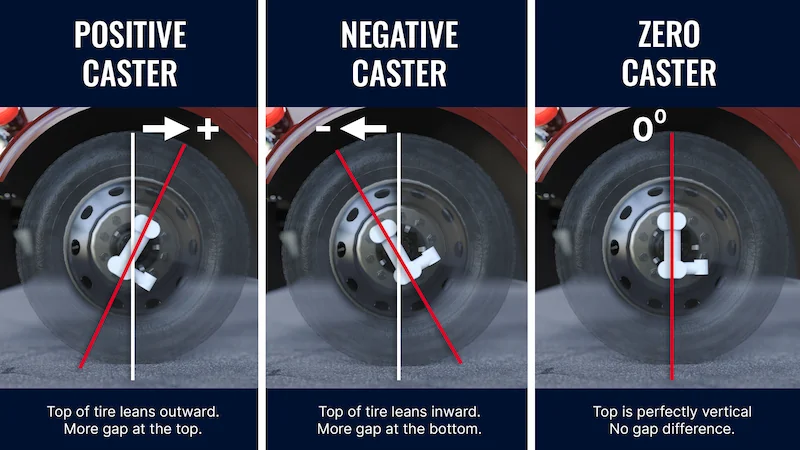
| Caster | The forward or backward tilt of the steering axis | Off-spec caster from worn bushings or bent parts | Usually, there is no direct tire wear, but it can cause wandering, heavy steering, or pulling. |
Toe wheel alignment in trucks
Toe is the most common cause of fast tire wear on commercial trucks. Even a small toe issue causes damage at every meter the truck moves, because the tire is dragged sideways instead of rolling cleanly.
Camber wheel alignment in trucks
Camber problems on heavy-duty trucks often point to worn kingpins or ball joints. When those parts have played, the truck will not hold alignment after adjustment. The same wear can return in as little as 10,000 km.
Caster wheel alignment in trucks
Caster usually does not create tire wear directly. However, a bad caster can make the truck wander on the highway. The driver then has to keep correcting the steering, which leads to fatigue on long runs.
Thrust angle, the Semi Truck Problem Many Shops Miss
On a semi truck, alignment is not only a front-end issue. The rear axles create a thrust line, which is the direction the truck gets pushed from behind.
When the rear axles do not track straight, the driver may keep correcting the steering without realizing the real issue sits behind the cab.
| Sign | What it means |
|---|---|
| Dog tracking | The rear wheels look offset from the front wheels when viewed from behind on a straight road |
| Steer tire wear keeps coming back | The front end may not be the real cause |
| Trailer tracking problems | Rear axle or trailer alignment may be off |
| Uneven fifth wheel loading | The truck may not be tracking square |
For semi truck alignment, the shop should check and set the rear axles before adjusting the front end. A shop that only performs front-end alignment on a multi-axle truck is solving only part of the problem.
How to Tell If Your Truck’s Wheels Are Misaligned
Signs of wheel alignment problems in a truck include uneven or feathered tire wear, pulling to one side, an off-center steering wheel, vibration through the steering column, tire squeal during normal turns, and an unexplained drop in fuel economy.
These symptoms often show up before a major failure. Catching them early helps save tires, fuel, and repair costs.
Tire Wear Pattern Guide
Different alignment problems leave different wear marks. Use this as a field reference during inspections.
| Wear pattern | What it looks like | Most likely cause |
|---|---|---|
| Feathering | Tread ribs feel sharp in one direction and smooth in the other | Toe misalignment |
| Inner shoulder wear | The inside edge wears faster than the rest of the tire | Negative camber or worn kingpins are causing camber drift |
| Outer shoulder wear | The outside edge wears faster | Positive camber |
| Even wear on both shoulders | Both edges wear faster than the center | Underinflation, not alignment |
| Patchy or cupped wear | Irregular low spots around the tread | Worn shocks or loose suspension, so inspect before blaming alignment |
Rapid overall wear on steer tires | The whole tire wears out quickly | Severe toe problem or long-term alignment neglect |
If both shoulders are wearing evenly, check truck tire pressure before blaming alignment. Underinflation can create that pattern even when the wheel angles are correct.
Uneven or Feathered Tire Wear
The tires usually tell the story first. They record the problem even when the driver has not yet felt it. Look across the tread face. If one edge wears faster than the other, check the alignment. Then run your palm across the tread ribs in both directions. If it feels smooth on one side and sharp on the other, the tire is feathered. That saw tooth feeling is one of the easiest ways to catch toe problems before the wear becomes obvious.
Check all axles, not only the steer tires. Drive axle and trailer axle wear patterns tell a different story than steer axle wear. Those differences help a mechanic determine whether the issue is the front end, rear tracking, or trailer alignment.

The Truck Pulls or Drifts to One Side
A truck that constantly pulls left or right may have an alignment issue. Test this only on a safe, flat road with light traffic. Hold the wheel steady, then briefly relax your grip for two or three seconds. If the truck immediately drifts in the same direction every time, the alignment may be off.
On Canadian highways, road crown matters. Many roads slope slightly to the right for drainage, so a small right drift does not always mean misalignment. Test in different lanes or directions when it is safe before making a call.
After 500 km of holding the wheel slightly off center just to keep the truck straight, a driver will feel the problem. That constant steering correction is often the alignment issue that shows up before tire wear becomes visible.
The Steering Wheel is Off Center
When the truck is driving straight, the steering wheel should be close to the center. If the wheel sits turned while the truck tracks straight, the alignment likely needs attention. Even a 5- to 10-degree difference is worth checking. It often points to toe or steering centering issues.
Vibration Through the Steering Column
Vibration does not always mean alignment is the problem. Wheel imbalance, damaged tires, bad bearings, and worn suspension parts can also cause vibration.
Still, alignment should be part of the inspection when the vibration develops slowly, and the tires also show uneven wear.
Tires Squeal During Normal Turns
Tire squeal during normal turns means the tire is being dragged instead of rolling cleanly through the corner. By the time squealing starts, uneven wear is already happening.
Fuel Economy Drops Without a Clear Reason
Misaligned tires increase rolling resistance. That forces the engine to work harder.
For fleets that track fuel use by route, this can show up as higher L/100 km before the driver notices a handling issue. If fuel consumption rises and the route, load, weather, and mechanical condition have not changed, check alignment before chasing more expensive problems.
Wheel Alignment for Trucks in Canada and DOT Inspection
Truck wheel alignment in Canada is not usually listed as a standalone DOT/CVSA inspection item, but it still matters before inspection. Misalignment can lead to uneven tire wear, steering issues, and suspension problems that may contribute to an inspection failure. Keeping your truck aligned helps support safer operation and reduces the risk of related component issues.
Key things to keep in mind:
- Severe uneven tire wear can raise inspection concerns.
- A steering wheel that is not centered can point to alignment problems.
- Pulling to one side may signal steering or alignment issues.
- Worn kingpins, ball joints, or suspension parts can affect alignment and inspection results.
- Regular alignment checks help improve tire life, fuel economy, and compliance readiness.
Root Causes: What Knocked Your Truck Out of Alignment?
| Cause | How it affects alignment | How to check |
|---|---|---|
| Pothole impact | Can shift toe or camber immediately. One hard hit at highway speed can transfer serious force. | Inspect steer tires and rim edges after a bad pothole hit |
| Worn tie rod ends | Allow the toe to shift under load | Ask the shop to check for play during inspection |
| Worn kingpins or ball joints | Cause camber to drift while the truck moves. The truck will not hold alignment after adjustment. | Perform a kingpin play check or have a technician inspect it |
| Worn bushings | Allow suspension geometry to flex | Include them in a full suspension inspection |
| Uneven cargo loading | Changes how the suspension sits under weight and can affect the thrust angle | Check load distribution before long runs |
| Normal mileage wear | Alignment can drift slowly without one obvious impact | Schedule regular checks every 25,000 to 40,000 km |
How to Do a Quick Alignment Check Yourself
These checks do not replace a computerized alignment machine. However, they help you decide whether alignment is likely the problem. They also provide the technician with more information when you book a service.
Tire Wear Inspection
Start with both steer tires. Then check the drive and trailer tires.
Use a tread depth gauge. Measure the inside edge, center, and outside edge of each tire. Record the tire position, the worn edge, and the depth difference.
For instance, a note like “right steer, inner shoulder, 4 mm deeper than outer” helps the technician. A note like “front tire wearing badly” does not.
A difference of 2-3 mm between the inside and outside of the same tire is a clear alignment warning.
The Hand Test for Feathering
Run your palm slowly across the tread ribs from the outer shoulder toward the inner shoulder. Then reverse direction and run your palm back the other way.
If the tread feels smooth in one direction and sharp in the other, the tire is feathered. That is a strong sign of toe misalignment, and it often shows up before visible wear becomes obvious.
The Straight Road Pull Test
Find a flat, level road with light traffic. Drive at a safe highway speed. Briefly reduce pressure on the steering wheel for two or three seconds, but do not let go completely.
Notice whether the truck drifts and which direction it goes. Repeat the test in the opposite lane when it is safe, so you can account for the road crown.
A truck that pulls in the same direction every time on a flat road needs an alignment inspection.
Steering Wheel Center Check
Park with the wheels pointed straight ahead. Look at the steering wheel logo or center mark.
If it sits noticeably off level while the tires are straight, the truck may have a toe or steering centering issue.
Kingpin Play Check for Heavy-Duty Trucks
This is one of the most important pre-alignment checks for heavy-duty trucks, and many guides skip it.
Safely jack the front axle under the spring and use proper jack stands. Grasp the tire at the 12 o’clock and 6 o’clock positions. Push and pull firmly to check for up-and-down movement.
Any rocking movement can indicate worn kingpins, ball joints, or wheel-end play.
This matters because worn kingpins prevent the truck from holding alignment. The shop needs to repair the worn parts first, then align the truck. Otherwise, the same wear can return in 10,000 km, along with a second alignment bill.

When to Book a Professional Truck Wheel Alignment
Knowing when to book a truck wheel alignment in Ontario can help prevent premature tire wear, poor fuel economy, and steering issues on the road. Wheels can go out of alignment due to hitting potholes, curbs, or uneven road conditions, or from general wear and tear on suspension and steering components. These signs usually indicate that the tires are not tracking straight, which can lead to faster tire wear, higher fuel consumption, and increased stress on the steering and suspension components.
One alignment check costs less than one replacement steer tire. Catching a toe problem at 15,000 km instead of 60,000 km can save a full set of tires.

Truck Wheel Alignment Cost vs. Truck Tire Replacement Cost
A front-end alignment for a commercial truck typically costs between $150 and $300 CAD. A full axle alignment on a semi truck usually costs more because it involves more axles and a more detailed setup. But when you compare that to a single steer tire replacement service, which costs $400 to $700, the alignment cost makes sense. It is a small preventive service that can help avoid premature tire wear and larger repair bills.
| Service | Estimated Cost in Canada | What It Means |
|---|---|---|
| Commercial truck front-end alignment | $150 to $300 CAD | A lower-cost service that helps prevent uneven steer tire wear |
| Full axle alignment on a semi truck | Higher than $300 CAD | Costs more because multiple axles and thrust angle may need adjustment |
| Single steer tire replacement | $400 to $700 CAD | One tire can cost more than a basic alignment |
| Multiple truck tire replacement | $2,000 to $4,000+ CAD | Premature wear across several tires can become a major expense |
| Mobile or roadside tire replacement | Tire cost + service call fee | Usually costs more because of travel, labor, and emergency service |
Why Professional Alignment Still Matters
A DIY check can point you in the right direction, but proper heavy-duty truck alignment requires the right equipment and trained technicians.
Professional shops use Hunter alignment systems to measure toe, camber, caster, thrust angle, axle offset, and related suspension angles across every axle. A technician should also inspect steering and suspension parts before making adjustments, as worn parts can cause the alignment to fail again within weeks. Misaligned wheels can have a cascading effect on spindles and bearing journals, increasing stress on axle setups.
Final Thoughts
Most truck wheel alignment problems show up in the tires and steering wheel before they become major failures. A quick tread check, a hand-feathering test, and a straight-road pull test can tell you within minutes whether something is wrong.
If your truck is pulling, wearing tires unevenly, or showing kingpin play during a pre-trip check, book a professional alignment inspection before the damage spreads through the suspension.

Frequently Asked Questions
A semi truck should have its alignment checked every 25,000 to 40,000 km. It should also be checked after a hard impact, suspension repair, steering repair, or new tire installation.
Trucks running rough Canadian routes, including post-winter potholes, construction detours, and unpaved resource roads, may need more frequent checks. A practical rule is simple. If the truck runs hard routes and it has been more than one season, check it.
The most common signs are feathered tread, uneven shoulder wear, consistent pull to one side, an off-center steering wheel while driving straight, vibration through the steering column, squealing during normal turns, and an unexplained rise in fuel consumption.
No, wheel alignment adjusts tire and axle angles so the truck tracks straight. Wheel balancing corrects the weight distribution around the tire and wheel assembly.
Both issues can cause vibration, but alignment is more closely linked to uneven tire wear. A truck can need both services at the same time, but they solve different problems.
Yes, misaligned wheels increase stress on tires, wheel bearings, tie rod ends, ball joints, kingpins, bushings, and suspension components.
Left unchecked, what starts as a simple alignment issue can turn into a much larger suspension or tire repair bill.
You can perform basic diagnostic checks, including tire wear inspection, hand feathering test, pull test, steering wheel center check, and kingpin play check. These checks take only a few minutes and can fit into a pre-trip inspection routine.
The final angle adjustment still requires a professional shop with heavy-duty computerized alignment equipment.
If the truck still pulls after alignment, the cause may be worn kingpins, bad bushings, damaged tires, brake drag, incorrect tire pressure, or rear axle thrust angle.
The alignment may be correct, but another part may still be causing the pull. Tell the technician which direction the truck pulls and what road conditions make it worse. That information helps narrow down the problem faster.