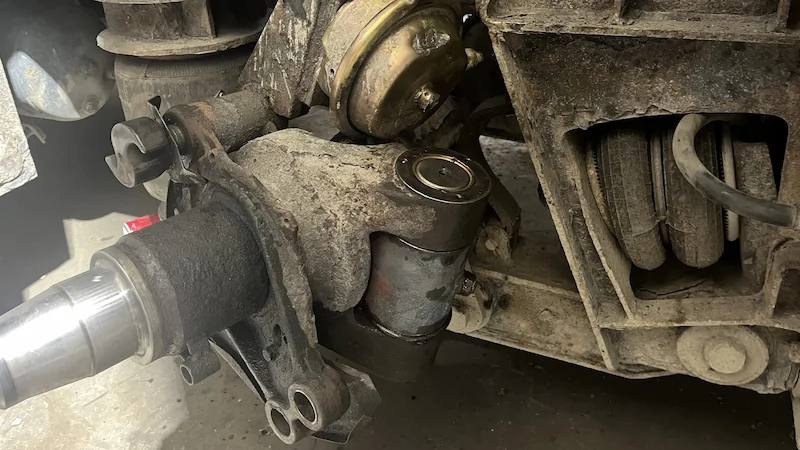
A kingpin on a truck is a sturdy steel pin that connects the steering knuckle to the front axle beam. It allows the front wheels to turn while carrying the truck’s weight. The term ‘kingpin’ is also used for the pin at the front of the semi-trailer that attaches to the fifth wheel on the tractor.
In this guide we’ll explains both meanings, but we’ll focus more on the steering kingpin because it is the main type of kingpin that requires repair, maintenance, and replacement of components on trucks. You’ll learn what the steering kingpin does, the signs of worn kingpins, how to check kingpins on a truck, and what replacement involves.
Steering Kingpin vs Trailer Kingpin: What Is the Difference?
Despite being referred to as kingpins, trailer kingpins and steering kingpins function in separate systems. Trailer kingpins connect the tractor and the trailer while steering kingpins form part of the front axle of the truck. Therefore, Knowing the difference matters because wear in each part causes a different type of problem. The table below makes that distinction clear.
| Attribute | Trailer Kingpin | Steering Kingpin |
|---|---|---|
| System | Coupling system | Steering system |
| Main role | Connects trailer and tractor | Supports steering pivot |
| Movement | Allows trailer articulation | Allows wheel turning |
| Failure risk | Trailer separation or coupling failure | Poor steering control |
| Inspection focus | Wear, cracks, secure mounting | Play, lubrication, bushing wear |
The Steering Kingpin on the Front Axle
The steering kingpin holds the steering knuckle to the axle beam on many heavy trucks with solid front axles. The steering knuckle carries the wheel-end hardware and rotates with them, while the axle beam bears the front axle loads.
The kingpin provides the knuckle with a strong rotating axis. The steering linkage controls the rotation of the steering knuckle around the kingpin and thus controls the turning of the front wheels to one side or another.
This part does two jobs at the same time. it steers the truck and supports vertical loads. That makes it different from a small steering part that only guides movement. A worn kingpin can cause truck wheel alignment issues change the way the truck tracks, turns, and holds alignment.
The same basic front-end idea applies across many heavy trucks, including Volvo, International, Freightliner, Kenworth, Peterbilt, and Mack models. Different types of axles and trucks have their own specific components, which means that an accurate inspection is necessary before buying a set or individual kingpins.

How the Steering Kingpin Works? Bushings and Thrust Bearing
A steering kingpin does not work alone. It works with kingpin bushings, a thrust bearing, seals, and grease. The bushings fit around the kingpin and support the turning movement of the steering knuckle. The thrust bearing carries vertical load between the axle and knuckle, so the front end can turn under weight. Grease keeps the pin, bushings, and bearing moving without metal grinding against metal.
That’s why dry kingpins often cause steering problems. Missed grease intervals let the bushings wear faster. Road salt, dirt, water, and high mileage can speed up that wear, especially on Ontario trucks that see winter roads.
| Steering Part | Function |
|---|---|
| Kingpin | Creates the steering pivot |
| Bushings | Support kingpin movement |
| Bearings | Reduce friction under load |
| Steering knuckle | Holds the wheel-end assembly |
| Axle beam | Supports the steer axle structure |
Kingpins vs. Ball Joints
Kingpins and ball joints do a similar job, but they use different designs. Kingpins are commonly used in heavy duty trucks which use solid front axles. On the other hand, light trucks and cars usually use ball joints, especially with independent front suspension. A ball joint is made up of a ball-and-socket construction.
The Fifth-Wheel Kingpin on a Semi-Trailer
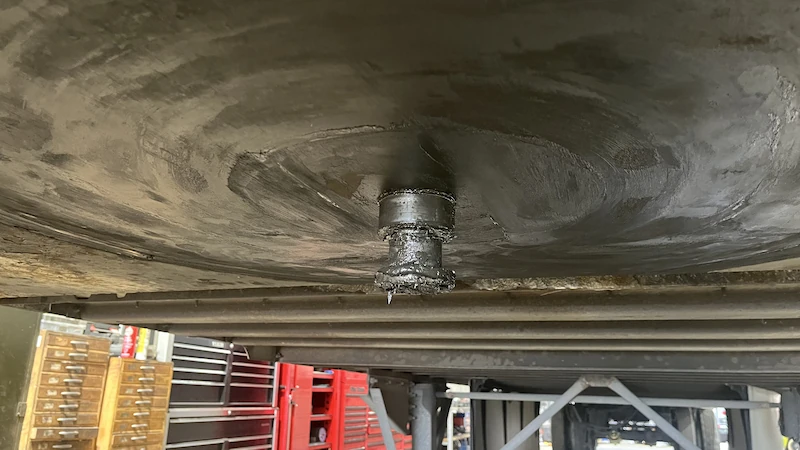
The fifth-wheel kingpin forms the main connection between the semi-trailer and the tractor’s fifth wheel. During coupling, the tractor backs beneath the trailer and the kingpin enters the throat of the fifth wheel. The locking jaws close around the kingpin’s locking section, securing the connection while allowing the trailer to pivot during turns.
Fifth-wheel kingpins come in two common sizes:
- 2-inch kingpin: Commonly used for general freight.
- 3.5-inch kingpin: Used for heavier applications, including heavy haul.
The kingpin must match the tractor’s fifth-wheel locking system. Incompatible sizes can prevent secure coupling and create a serious separation risk. SAE J700 provides dimensional requirements for trailer kingpins. Service limits may also depend on the trailer manufacturer, fleet inspection program, and applicable safety rules.
A trailer kingpin should be inspected for wear around the locking section, cracks, bends, and damage to the welds or upper coupler. Shops use a kingpin gauge to determine if the wear has exceeded the service limit. If it has, the trailer needs repair before returning to service.
Where Is the Kingpin Located on a Trailer?
The trailer kingpin projects downward beneath the front of the semi-trailer, at the center of the upper coupler plate. It is easiest to see when the trailer is uncoupled and supported by its landing gear. The table below shows the surrounding coupling components and their relationship to the kingpin.
| Component | Position | Relationship to Kingpin |
|---|---|---|
| Upper coupler plate | Trailer underside | Holds the kingpin |
| Fifth wheel plate | Tractor frame | Receives the kingpin |
| Locking jaws | Inside fifth wheel | Grip the kingpin |
| Release handle | Fifth wheel side | Opens or confirms lock status |
| Landing gear | Trailer front | Holds trailer height before coupling |
How Does the Trailer Kingpin Work?
A trailer kingpin works by locking into the fifth wheel. The fifth wheel jaws grip the kingpin groove. This locked connection lets the tractor pull the trailer while allowing controlled rotation during turns.
The coupling process follows a clear mechanical sequence:
- Align the tractor with the trailer.
- Back the fifth wheel under the trailer nose.
- Guide the kingpin into the fifth wheel throat.
- Lock the fifth wheel jaws around the kingpin.
- Perform a tug test and visual inspection.
- Connect air lines and electrical lines.
The kingpin does not work alone. The fifth wheel, locking jaws, upper coupler plate, release handle, and mounting hardware form the coupling system.
What Causes Kingpin Wear?
The causes of wear in a kingpin vary depending on whether it is a steering kingpin or a trailer kingpin. Wear occurs in the steering kingpin at the front-axle assembly while in the trailer kingpin due to wear caused by interaction with the fifth wheel. The two parts have to withstand great load, movement, friction, and contamination with dirt. The only major difference is the wear location.
| Wear Factor | Steering Kingpin | Trailer Kingpin |
|---|---|---|
| Poor lubrication | Dry bushings and thrust bearing | Increased fifth-wheel friction |
| Worn components | Loose or worn bushings | Worn fifth-wheel jaws |
| Contamination | Failed seals, dirt, salt, and water | Corrosion and surface pitting |
| Heavy loads | Front-axle weight and road impacts | Pulling and braking forces |
| Misalignment or damage | Uneven steering-component pressure | Rough coupling or damaged upper coupler |
| Repeated use | High-mileage steering cycles | Frequent coupling cycles |
What Are Signs of a Bad Kingpin?
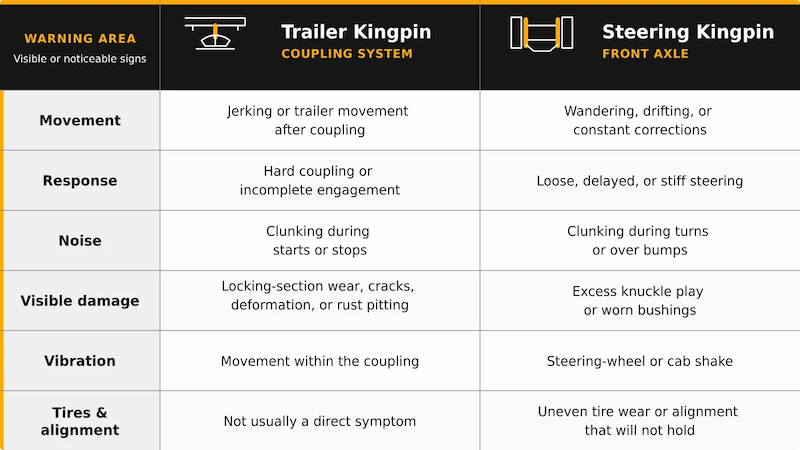
The warning signs depend on which kingpin is damaged. A worn trailer kingpin affects the connection between the trailer and fifth wheel, while steering kingpin wear affects the movement and stability of the front wheels. Because these parts serve different systems, they produce different symptoms.
Trailer kingpin problems are usually noticed during coupling or when the truck starts, stops, or changes direction. Steering kingpin wear is more likely to affect handling, steering response, tire wear, and front-end stability. The comparison below shows the most common warning signs for each type.

How to Check Kingpins on a Truck
A kingpin check starts by lifting the front axle so the wheel has no weight on it. The truck must sit safely on proper stands before anyone works around the wheel end.
First, remove or isolate wheel bearing play so it does not fool the test. A loose wheel bearing can mimic kingpin movement. A technician may snug the wheel bearing or use the brake during the check, depending on the axle and shop procedure.
Next, grab the tire at the 12 and 6 o’clock positions and rock it top to bottom. Movement in that direction can point to kingpin or bushing wear. A pry bar under the tire can also help show vertical movement, but a visual check alone does not give a real measurement.
A dial indicator gives the proper reading. The indicator measures axial or lateral kingpin play while the wheel or knuckle moves. As a common heavy-truck diagnostic limit, movement should not exceed about 0.120 inch, or roughly 1/8 inch. If it does, the kingpin, bushings, or related parts need replacement.
Canadian inspections also look at rocking play at the tire tread face. A failed commercial vehicle inspection can lead to downtime, repair orders, and out-of-service risk. That matters for fleet trucks, owner-operators, and commercial vehicles that need to stay CVIP-ready or meet similar provincial inspection rules.

Can You Drive With a Worn Kingpin?
You should not drive with a worn, cracked, loose, or improperly locked kingpin. A damaged kingpin can reduce coupling security. A failed kingpin or fifth wheel lock can cause trailer separation.
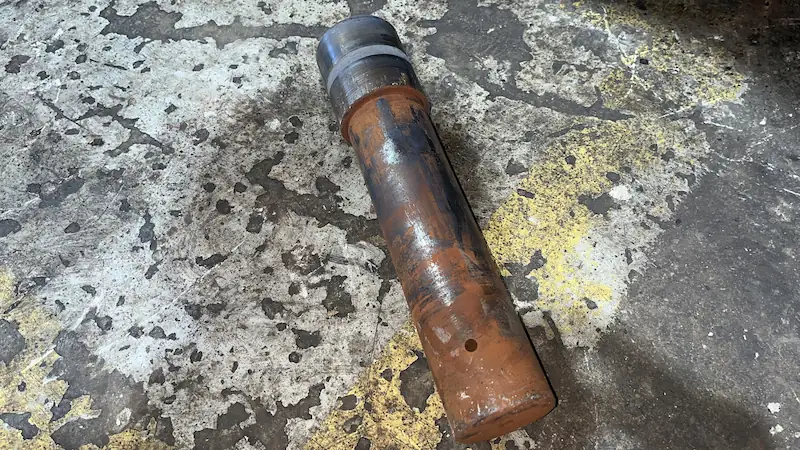
A minor surface mark does not always mean failure. A qualified technician should measure wear and inspect related parts. The fifth wheel, jaws, mounting plate, kingpin, and upper coupler work as one safety system.
Replacing Kingpins: Cost, Time, and Safety
Kingpin replacement usually means installing a kingpin set or kit. A proper kit includes the kingpins, kingpin bushings, thrust bearings, seals, and related hardware. The bushings must fit the new pins correctly, so the job often requires reaming. Reaming sizes the bushings with precision after installation.
This is not a quick bolt-on repair. A heavy-truck kingpin job can take about eight hours of shop time because the front end must come apart, the old parts must come out, the bushings must be fitted, and the steering must move smoothly after assembly.
A kingpin kit commonly runs about $500 to $1,500, with heavy-duty applications at the higher end. Labour adds to that cost. The final price depends on the axle, truck make, corrosion, damaged knuckle or axle parts, and how easily the old kingpins come out.
Do not ignore real kingpin play. Once the front end has measurable looseness, steering control drops and tire wear increases. Worn kingpins beyond spec can fail a CVIP or similar provincial commercial vehicle inspection and can put the truck out of service.
How Do You Maintain a Truck Kingpin?
You can maintain a truck kingpin by inspecting it, lubricating related contact points, checking fifth wheel lock condition, and fixing wear early. Trailer kingpins need clean fifth wheel lubrication. Steering kingpins need grease at scheduled intervals.
| Maintenance Task | Trailer Kingpin | Steering Kingpin |
|---|---|---|
| Visual inspection | Required | Required |
| Lubrication | Fifth wheel grease | Kingpin grease fittings |
| Wear measurement | Kingpin gauge | Play measurement |
| Related part check | Fifth wheel jaws | Bushings and bearings |
| Safety action | Remove from service when unsafe | Repair before steering control worsens |
When a Kingpin Needs Professional Attention
A steering kingpin and a trailer kingpin serve different systems, but wear in either one can create serious safety problems. Early inspection helps identify the worn component before it causes further damage, an inspection failure, or extended downtime.

Frequently Asked Questions
No. A kingpin is the trailer pin. The fifth wheel is the tractor-mounted coupling plate. The kingpin locks into the fifth wheel.
A failed trailer kingpin can cause coupling failure or trailer separation. A failed steering kingpin can cause poor steering control and unsafe handling.
A damaged trailer kingpin usually needs replacement, not casual repair. Steering kingpins often need replacement with bushings, bearings, or related axle parts.
A kingpin should be checked during pre-trip inspections and preventive maintenance. Fleet schedules, mileage, duty cycle, and manufacturer guidance control inspection frequency.
They do the same steering pivot job in different ways. Heavy trucks with solid front axles often use kingpins. Light trucks and cars usually use ball joints because their front suspension design uses a ball-and-socket pivot.