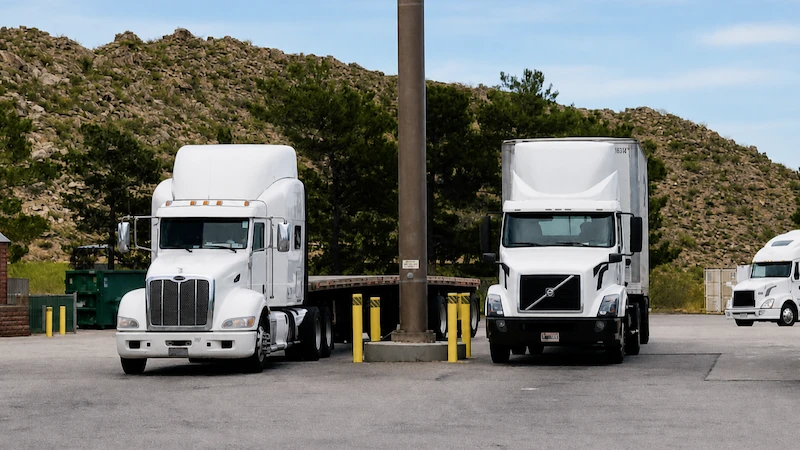
A semi truck has a tractor connected to a detachable semi-trailer, consisting of rear axles but no front road axle, so its front end is supported by the tractor’s fifth wheel. This is where the term “semi” comes from.
“Full truck” is not a universally standardized vehicle classification. It may refer to a straight or rigid truck, in which the cab and cargo body share the same chassis, or to a full trailer, which supports its own weight on its front and rear axles.
The distinction is important because these vehicle types have very different axle and suspension layouts, which affect inspection, maintenance, and repair. Let’s take a look at how each setup differs and what those differences mean for service and repair
Why is it Called a Semi?
The semi refers to the trailer, not the tractor or the vehicle’s size. A semi-trailer is only partly self-supporting. The rear axle group carries the back. The front has no road axle at all and leans on the tractor. That is the whole reason for the word.
The name goes back further than most people expect. In 1914, Detroit blacksmith August Fruehauf built a trailer for lumber dealer Frederic Sibley that hitched to a modified Ford Model T. The Henry Ford collection treats that unit as the ancestor of the modern freight semi-trailer.
So, “semi” does not mean half-size. It refers to how the trailer is supported. A semi-trailer carries part of its weight on the tractor rather than on its own axles.
What Actually Connects a Semi-Truck and Trailer?
Look underneath the front end of a semi-trailer, where it connects to the tractor, and the setup becomes much easier to understand. The tractor carries a fifth wheel, the large coupling plate mounted behind the cab. The semi-trailer has a kingpin underneath its front section. When the tractor backs under the trailer, the kingpin enters the fifth wheel and the locking jaws close around it. Once connected, the tractor and trailer can pivot at this coupling as the vehicle turns.
The fifth wheel does more than connect the two units. It also supports part of the semi-trailer’s weight by transferring that load to the tractor frame and drive axles. This is why the condition of the axle and proper weight distribution matter so much on a tractor-semitrailer.
To understand how that load is handled by the powered axle assembly, learn more about how a drive axle works on a truck.
When a semi-trailer is uncoupled, the landing gear supports the front of the trailer. It is designed for parking and support, not for road travel. A full trailer works differently. It supports itself on its own front and rear axles and typically connects through a drawbar and coupling, such as a pintle hitch.
That difference also changes what technicians inspect:
- Fifth wheel locking components
- Trailer kingpin
- Mounting hardware
- Lubrication
- Fit between the fifth wheel and trailer apron

What About a Straight Truck or Box Truck?
When people say “full truck,” they may be referring to a straight truck. Unlike a tractor-trailer, a straight truck has the cab and cargo body mounted on the same chassis.
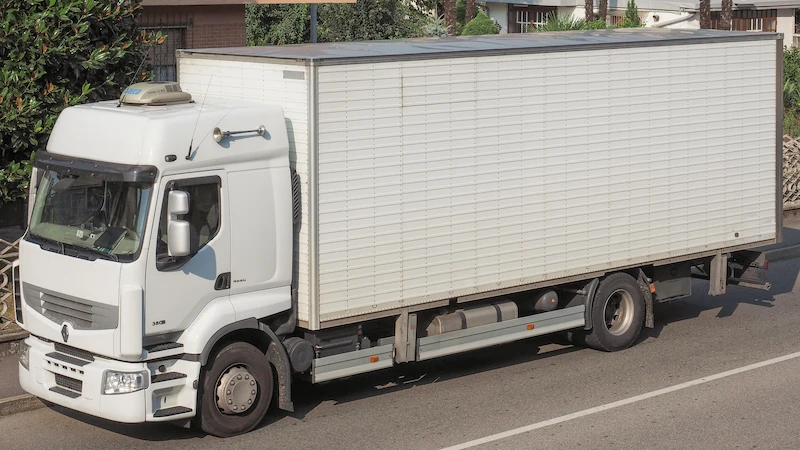
A box truck is a common example. Since there is no trailer connection or fifth wheel between the cab and cargo area, the vehicle moves as one unit.
Compared with a tractor-trailer, straight trucks are generally:
- Easier to maneuver in cities and tight spaces.
- Commonly used for local deliveries and shorter routes.
- Unable to drop and swap the cargo body as a tractor can with trailers.
Legal Truck Weight Capacities For Semis and Full Trucks
In Ontario, legal truck weight depends on axle count, axle spacing, tire width, and SPIF configuration.
- Straight truck: Usually carries less because the load is supported on fewer axles. Depending on configuration, legal weight may range from about 17,000 kg to 36,000 kg.
- Semi-truck: Can carry more because the load is spread across the tractor and trailer axles. A typical 5-axle combination may reach about 39,500 kg.
- Heavy multi-axle combinations: Specialized configurations can reach up to 63,500 kg (140,000 lb) where permitted.
The exact limit depends on the vehicle’s axle configuration, so operators should always check the current Ontario Vehicle Weight and Dimension Guide before loading.
While standard configurations usually max out at around 39,500 kg (approx. 87,000 lb) for a basic 5-axle setup, the heaviest permitted multi-axle configurations legally reach up to 63,500 kg (140,000 lb). The Ontario Vehicle Weight and Dimension Guide sets out these precise metric charts by configuration.
Why a Semi Needs More Room to Turn?
Off-tracking happens when the rear wheels take a tighter path through a turn than the front wheels.
All trucks do this, but it is more noticeable with a tractor-trailer because the trailer pivots at the fifth wheel. This means:
- The tractor may clear a corner while the trailer wheels cut closer to the curb.
- Drivers need to plan wider turns at intersections, loading yards, fuel stations, and other tight spaces.
- Reversing requires greater steering control because small movements can quickly change the trailer’s angle.
A straight truck moves as one unit, making turning and backing generally simpler than with an articulated tractor-trailer.
Drop-and-Hook, The Reason Semis Dominate Long-Haul!
The detachable trailer gives a semi-truck an important advantage called drop-and-hook. A driver can leave one trailer and connect to another without waiting for freight to be unloaded.
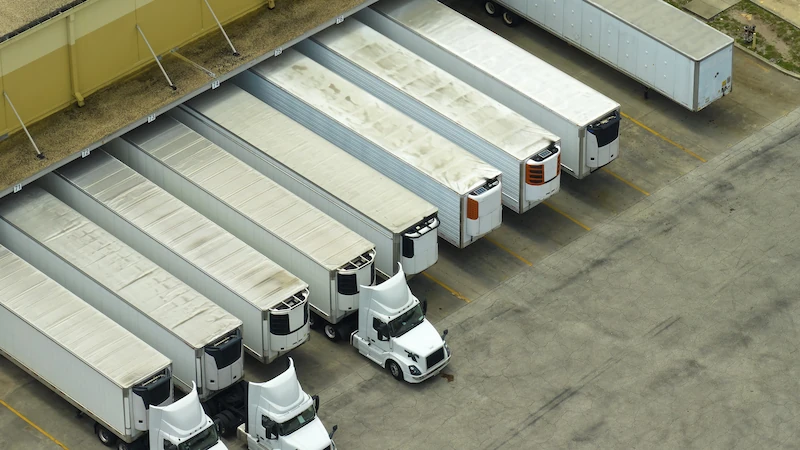
- Semi-truck: The trailer can be dropped and swapped, reducing loading and unloading downtime. The trade-off is more coupling components, such as the fifth wheel, kingpins, air lines, and glad hands, that require regular inspection.
- Straight truck: The cargo body stays attached to the chassis, so the entire truck remains while freight is loaded or unloaded. However, there are fewer coupling components to maintain.
For fleets moving multiple loads, the semi-truck offers more flexibility, while the straight truck provides a simpler overall setup.
Which is better for common hauling jobs?
Choosing between a semi-truck and a straight truck depends on the type of freight, distance, and delivery location. Semi-trucks work well for larger loads and longer routes, while straight trucks are often more practical for local jobs and frequent stops.
Here is how they compare for common hauling jobs.
| Job | Which Truck | Reason |
|---|---|---|
| Long-haul general freight | Semi Truck | Cargo capacity |
| Warehouse to warehouse | Semi Truck | Trailer interchange |
| Urban multi-stop delivery | Full Truck | Maneuverability |
| Residential moving | Full Truck | Site access |
| Heavy equipment transport | Semi Truck | Specialized trailer options |
| Local food distribution | Full Truck | Frequent stops |
| Large refrigerated freight | Semi Truck | Trailer volume |
| Parcel distribution | Full Truck | Frequent local stops |
| Intermodal containers | Semi Truck | Container chassis compatibility |
| Waste collection | Full Truck | Integrated body |
| Concrete delivery | Full Truck | Integrated mixer body |
What License Do You Need to Drive Each Truck in Ontario?
According to the Ontario MTO handbook, commercial truck licensing requirements depend on the vehicle type and the weight of the trailer being towed.
Class D (Straight / Rigid Trucks)
Allows you to drive any truck or combination exceeding 11,000 kg (24,000 lbs) gross weight or registered gross weight. You may tow a trailer, provided the trailer’s gross weight does not exceed 4,600 kg (10,000 lbs). Common examples: Dump trucks, cement mixers, and heavy box trucks.
Class A (Tractor-Trailers)
Required for any combination of a motor vehicle and a towed vehicle where the trailer’s gross weight exceeds 4,600 kg (10,000 lbs). This is the standard license required for traditional tractor-semitrailers.
Class A Restricted (AR)
If you pass your Class A road test pulling a trailer that weighs over 4,600 kg but does not have a full air brake system (such as a heavy utility trailer pulled by a large pickup), you will receive a restricted “AR” license. You cannot drive a full tractor-semitrailer with an AR license.
The Z Endorsement
Required to operate any vehicle equipped with air brakes. The “Z” is a separate endorsement added to your existing license class (creating a DZ or AZ license).
Semi Vs Full Truck: Final Comparison
The clearest way to distinguish the terms is to place all three vehicles side by side. The key is not overall size. It is the frame, the axle support, and the coupling. These features must be considered together because one characteristic alone may not accurately identify the complete setup. The table below shows how they align across the three vehicle types and provides a clear final reference.
| Feature | Semi-Truck | Full Trailer Setup | Straight/Box Truck |
|---|---|---|---|
| Basic setup | Tractor + semi-trailer | Towing vehicle + self-supporting trailer | Cab and cargo body on one chassis |
| Coupling | Fifth wheel and kingpin | Drawbar or similar coupling | No trailer coupling in normal use |
| Front trailer support | Supported by tractor when coupled | Supported by its own wheels or a dolly | Not applicable |
| Axle layout | Axles under tractor and rear of trailer | Trailer supports its weight on front and rear wheel groups | Axles under one chassis |
| Articulation | Pivots at fifth wheel | Pivots at trailer connection | Does not articulate |
| Maneuverability | Requires more turning room | Can have multiple pivot points | Easier in tight spaces |
| Common uses | Long-haul freight, heavy loads, drop-and-hook | Specialized hauling and trailer combinations | Local delivery, moving and urban freight |
| Ontario licence | Usually Class A | Depends on trailer and combination weight | Often Class D for heavy units |
Different Setups, Same Need for Proper Repairs
Semi-trucks, full trailers, and straight trucks carry and distribute weight differently, but each depends on reliable axles, spindles, suspension, and wheel-end components. At AxleSpindle, we have over 20 years of experience repairing commercial trucks and trailers at our full-service Mississauga shop and through our mobile service across the GTA and Southern Ontario. Our team understands the repair needs of each configuration and completes the work needed to get your equipment safely back on the road.

Frequently Asked Questions
A semi-truck is called a tractor-trailer because it combines two units: the tractor, which provides the engine and pulling power, and the semi-trailer, which carries the cargo and connects to the tractor via a fifth wheel.
Usually, when people are comparing it to a semi. But “full truck” is not a standard term and can also mean a full trailer, a full-size pickup, or a fully loaded truck. Use the term “straight truck” or “rigid truck” if you want to be understood.
No, it has a rear axle group and landing gear. The landing gear only holds the trailer up while it is parked. It is not a road axle.
In everyday use, yes. Strictly speaking, tractor-trailer refers to the entire combination, and tractor is just the powered unit. Fleet paperwork treats them as separate assets because they are registered, loaded, and maintained separately
It usually means one, but not every semi has 18 wheels. Axle count varies by configuration, and lift axles, wide-base singles, and heavy-haul setups all affect it. It is a nickname, not a classification.
Yes, that is called bobtailing. Weight distribution and braking change noticeably when the trailer comes off, so it does not handle like the same truck.
Yes, if the ratings, coupling equipment, license class, and regulations allow it. It does not become a highway tractor by doing so, and the combination may fall under different licensing rules than the truck on its own.
A semi-trailer transfers part of its weight to the towing tractor. A full trailer generally supports its load through its own axle system and connects to the towing vehicle through a drawbar-type arrangement.