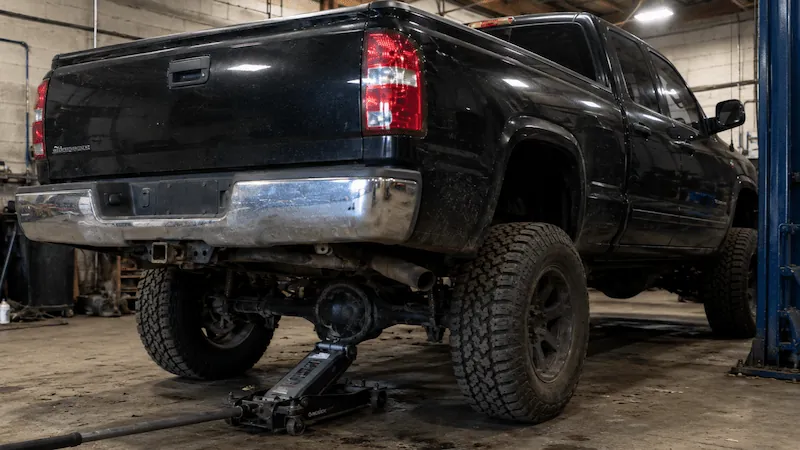
Trucks with a solid rear axle can be lifted using the rear differential provided that it is recommended to lift the vehicle by this point according to the manufacturer’s guidelines.
It should be noted that a jack must be applied to the differential housing and not the differential cover itself. Jack stands should also be set up at designated points before any work starts.
This issue varies depending on the truck model. A solid rear axle, an independent rear axle, and an aluminum differential housing each have separate lifting procedures.
Is the Rear Differential a Safe Jacking Point?
Many pickup trucks, including the F-150, Silverado, RAM 1500, Tundra, and Tacoma, use a solid rear axle. In this setup, the axle tubes, differential housing, leaf springs, and spring perches work together as one assembly.
When the truck is on the ground, its weight is carried through the springs and into the axle tubes. The center section of the axle, often called the pumpkin, is a strong structural part of the rear axle assembly. It is not the same as a thin body panel or a weak pinch weld.
That is why mechanics commonly lift the rear of a solid-axle truck from the center differential area. This raises both rear wheels at the same time and helps with tire rotations, brake work, wheel seal checks, and basic axle service. This guide applies only to trucks with a solid rear axle, so always follow the truck’s manual for the correct and safe jacking method.
When Should You Not Jack Up a Truck by the Rear Differential?
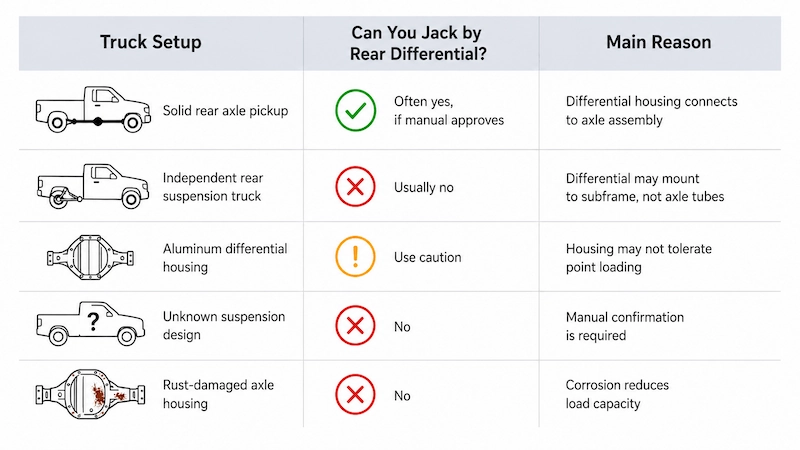
You should not jack up a truck by the rear differential when the manual does not approve that point, when the truck has independent rear suspension, or when the differential housing shows rust, cracks, or leakage.
Avoid rear differential jacking in these cases:
- Use another lift point when the owner’s manual names frame points only.
- Avoid the differential when the truck has independent rear suspension.
- Reject the lift point when the housing has heavy rust or impact damage.
- Avoid contact with the rear cover on stamped steel covers.
- Stop lifting when the jack saddle slips or tilts.
- Do not lift on uneven ground.
A truck lift point must support vertical load without sliding, bending, or damaging connected parts.
How Do You Jack Up a Truck by the Rear Differential Safely?
- Prepare the truck
Place the truck on level ground and shifting into Park. Then pull the parking brake. - Chock the front wheels
Chock the front wheels with wheel chocks in front and behind the front tires. This prevents the truck from rolling. - Position the jack
Slide the jack under the center of the rear differential housing. It must contact the solid housing, not the differential cover. - Lift the truck
Lift the truck slowly, raising it only as high as needed. - Set the jack stands
Place one jack stand under each axle tube, one on each side of the differential. - Lower the truck
Lower the truck slowly until the axle rests fully on the jack stands. - Check stability
Give the truck a firm shake to confirm it’s stable before working underneath.
Lifting a truck by the rear differential can be done safely, but only with the correct lift point and proper support. Before starting, park the truck on a flat surface and ensure your jack and stands are rated for the vehicle’s weight.
Where to Put the Jack Stands
After lifting the truck by the differential, place the jack stands under the axle tubes. The axle tubes are the solid steel sections that run from the differential housing out toward each wheel.
Position the stands as close to the wheels as practical. Avoid placing them directly under springs or other suspension components unless your vehicle manual lists those areas as approved support points.
Never leave the truck supported only by a floor jack. Floor jacks can slowly lose pressure, especially older ones. Jack stands are designed to hold a static load and provide safer support while you work.
| Type of Repair | Best Jack Stand Location | Reason |
|---|---|---|
| Rear tire change | Axle tube or approved frame point | Supports wheel service |
| Brake work | Axle tube or approved frame point | Keeps axle stable |
| Differential fluid service | Axle tubes | Keeps differential accessible |
| Leaf spring work | Frame points | Lets axle move separately |
| Shock replacement | Depends on design | Suspension may need loaded or unloaded position |
| Rear axle removal | Frame points | Axle cannot support itself during removal |
The correct lift point matches the repair goal. Tire work, brake work, suspension work, and differential service do not always use the same support points.
Important note: Never place the jack on the differential cover or drain plug. Also, do not assume every truck can be lifted from the rear differential. The correct lift point depends on the axle design and the manufacturer’s instructions.
Can Jacking by the Rear Differential Damage a Truck?
Yes, jacking a truck by the rear differential can cause damage if the jack contacts the cover, the wrong part of the housing, or an unapproved lift point.
Common damage can include:
- Bending the differential cover
- Breaking the cover gasket seal
- Causing gear oil leaks
- Crushing the drain plug
- Scraping aluminum housing ribs
- Bending nearby brackets
- Stretching brake lines or ABS wires
- Creating jack slippage because of poor saddle contact
Correct jack placement reduces the risk of damage. Jack stands are also required because they take the vehicle’s weight off the hydraulic jack and provide stable support.

What Type of Jack Should You Use for a Truck Rear Differential?
Choose a floor jack that is rated to carry at least the weight of your truck’s rear end axle. A car jack that is under-rated cannot lift most trucks.
The features of a good truck jack are:
- Rated capacity that exceeds the load
- Large saddle surface area for stability
- Long operating lever for control
- Caster wheels to work on smooth concrete floors
- Sufficient lift height to accommodate truck tire size
- Sufficiently wide support base
A bottle jack can lift some trucks; however, its narrow contact area and small base may make it difficult to lift.
Is It Better to Jack a Truck by the Frame or Rear Differential?
The frame is better when the repair requires unloaded suspension. The rear differential is faster when you need to raise both rear wheels on a solid rear axle and the manual approves it.
| Jacking Point | Best Use | Main Limit |
|---|---|---|
| Rear differential housing | Raises both rear wheels together | Must be approved by manual |
| Axle tube | Raises one rear side or supports rear axle | Must avoid brake lines and brackets |
| Frame rail | Unloads suspension | May need more jack height |
| Factory pinch point | Common on unibody vehicles | Not common for body-on-frame trucks |
| Trailer hitch | Not a recommended primary lift point | Hitch geometry can slip |
Does Truck Type Change the Rear Differential Jacking Rule?
Truck type makes a difference because different rear axles create different loading paths for the truck.
A solid rear axle truck usually depends on axle assembly for supporting the rear lift operation. On the other hand, an independent rear suspension truck does not rely on the differential housing at all for moving the wheels. These differences influence the choice of jack points.
Solid Rear Axle Trucks
In a solid rear axle truck, both rear wheels are connected by means of the same axle assembly, which includes the differential housing between wheels.
Common trucks include many half-ton, three-quarter-ton, and one-ton trucks.
Independent Rear Suspension Trucks
In independent rear suspension trucks, wheels move independently and the differential housing is not attached directly to the body of the vehicle, but instead is suspended between the two rear wheels separately.
Stick to factory lift points instead of improvising.
Lifted Trucks
If your truck has been lifted, you’ll need more room underneath, but lift kit does not affect the location of the proper jacking points.
Make sure you have enough space under the truck by using wheel chocks and wider jack stands. Do not stack wood pieces under your jacks.
What Mistakes Make Rear Differential Jacking Unsafe?
The biggest mistakes are lifting under the cover, skipping jack stands, using a weak jack, and working on sloped ground.
Avoid these errors:
- Do not lift under the differential cover.
- Do not crawl under a truck held only by a jack.
- Do not use a jack with unknown capacity.
- Do not lift on gravel, dirt, or a slope.
- Do not place stands under brake lines.
- Do not trust rusted axle housings.
- Do not use cinder blocks as stands.
- Do not lift from the driveshaft or pinion yoke.
- Do not exceed the jack’s rated capacity.
- Do not ignore the truck’s factory lift points.
A safe lift needs three parts: approved contact point, stable lifting surface, and rated support stands.
What Should You Check Before Lifting the Rear Differential?
Check the manual, axle condition, ground surface, jack rating, and jack stand rating before lifting the rear differential.
Use this checklist:
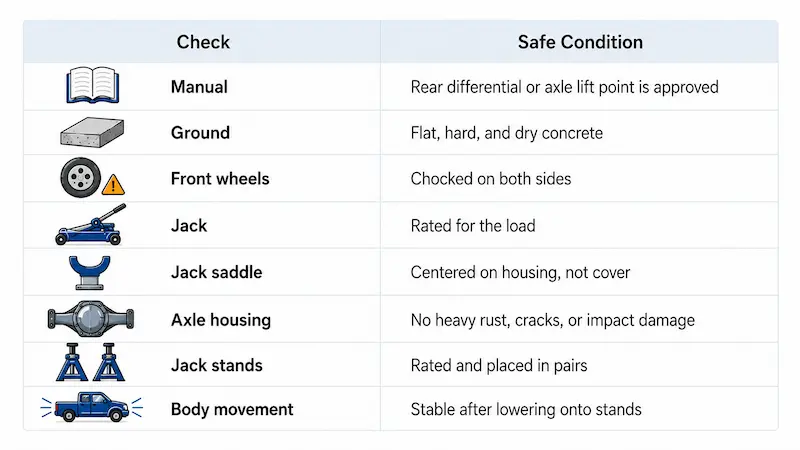
Can You Jack Up One Side of the Rear Axle Instead?
Yes, but only if you lift at a proper point for the axle tube or frame, depending on the truck type and work being done.
Lift one side when replacing or servicing one tire or one brake system assembly. Lift the center differential for raising both rear wheels when required by the manual.
Never jack under a narrow bracket, shock mount, U-bolt, or brake line mount unless specified in the manual.

Can You Use a Jack Pad on the Rear Differential?
Yes, a jack pad can improve contact when it fits the jack saddle and doesn’t create slip.
A rubber pad can protect painted surfaces. A pad can also reduce metal-to-metal sliding. The pad must stay centered under the housing. Avoid thick soft pads that deform under truck weight.
What is the safest option
The answer is to jack the truck only at factory-approved lift points and support it with jack stands before placing any body part under it. Rear differential lifting can be normal on some solid axle trucks. It can be wrong on other trucks. The manual removes guesswork.
If you would rather leave the job to an experienced certified mechanic, you can book our mobile truck repair services. We fix all kinds of axle spindle damage, wheel bearing failure, leaking axle seals, brake work, suspension issues, tire removal, differential leaks, and wheel-end noise. A mobile technician will lift your truck safely, inspect the problem, and handle the repair at your location.

Frequently Asked Questions
Yes, you can jack up many solid rear axle trucks by the rear differential when the manual approves it. Place the jack under the differential housing, not the cover, and support the truck with jack stands.
It is bad when the differential is not an approved lift point or when the jack contacts the cover. Correct housing contact on an approved solid axle truck can be acceptable.
Yes, many 4×4 trucks with solid rear axles can be lifted by the rear differential if the manual allows it. Four-wheel drive does not replace manufacturer lift-point guidance.
Yes, many solid rear axle trucks can rest on jack stands under the axle tubes. Place stands away from brake lines, brackets, and damaged metal.
No, you should not jack up a truck by the differential cover. The cover seals gear oil and can bend, leak, or slip under a jack saddle.
A floor jack is often better on flat concrete because it has a wider base and smoother lifting control. A bottle jack can work only when capacity, height, and stability match the truck.
Yes, apply the parking brake before lifting. Chock the front wheels because rear lifting can change tire contact and vehicle stability.
Yes, you can change rear tires after lifting by the differential if the truck rests on jack stands. Do not remove wheels while the truck depends only on the jack.
Yes, a lifted solid axle truck may be jacked by the rear differential when approved by the manual. Use a high-capacity jack, tall rated stands, and a flat surface.
The best rear jack point is the manufacturer-approved lift point for your truck and repair task. On many solid axle trucks, that point may be the rear differential housing or axle tube.