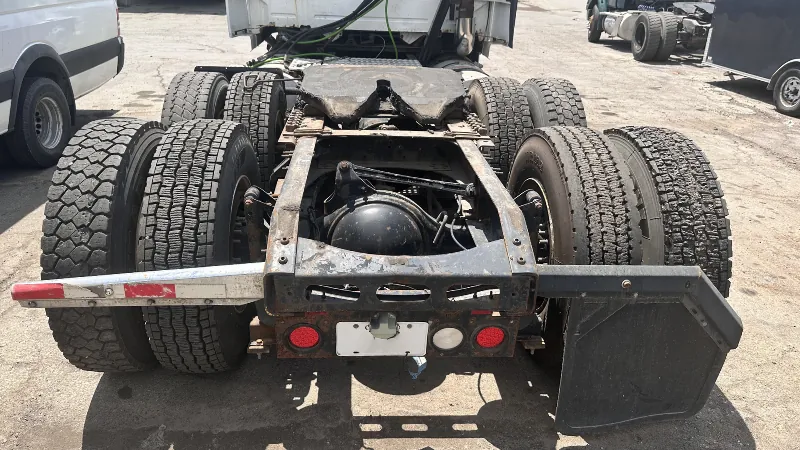
The drive axle on a truck converts engine torque into wheel rotation and powers the truck along the road. On most semi-trucks, the drive axle sits at the rear of the tractor, behind the cab and the steer axle.
On a conventional road tractor or most heavy‑duty trucks, the drive axle is the only axle that the engine powers. The others roll, steer, or carry weight, but don’t send power to the road. (Some all‑wheel‑drive or off‑road trucks can have powered front axles as well.)
The drive axle is not a single part. It’s a full assembly of housing, differential, axle shafts, bearings, hubs, seals, and wheel ends, all working together. It handles torque and load at the same time. A truck may have one drive axle or several drive axles, depending on truck size, payload needs, terrain, and drivetrain layout.
This article focuses on truck drive axles, not CV axles used in cars. We will cover the drive axle’s location, main parts, role in the drivetrain, and how it compares with other axles found on trucks..
What Does a Drive Axle Do?
A truck’s drive axle takes the spinning force coming off the driveshaft and hands it to the wheels. That force is what gets the truck moving, lets it pull, gets it up a grade, and lets it haul serious weight. On top of that, the drive axle is holding up a big share of the truck’s own weight, so it’s easily one of the hardest-working parts on the whole tractor.
The drive axle performs three main functions:
- Transfers torque from the drivetrain to the wheels.
- Supports weight from the chassis, cargo, and trailer load.
- Improves traction by applying power to the road surface.
Here’s how that power actually travels. The engine makes torque. The transmission adjusts that torque, trading speed for pulling power or the other way around. From there the driveshaft (you’ll also hear it called a propshaft) carries the spinning force back into the drive axle. Once it’s inside the axle housing, the differential turns that power sideways and feeds it through the axle shafts to the wheel.
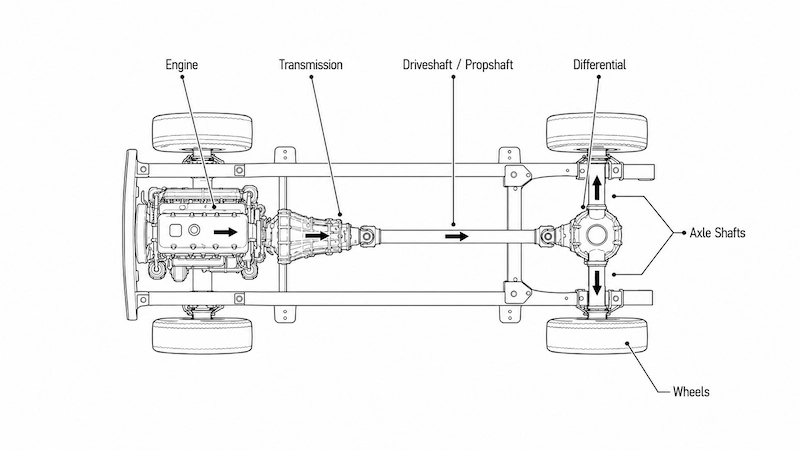
All of this matters because a truck is carrying far more weight than any passenger vehicle ever will. That extra load is exactly why the axle housings, bearings, shafts, gears, and suspension connections on a heavy truck have to be built so much stronger.
The Role of the Differential
The differential’s main job is to split torque between the left and right wheels. It also lets those two wheels spin at different speeds when you’re going around a corner, since the outside wheel has farther to travel than the inside one. Without that, the tires would scrub and fight their way through every turn.
A lot of heavy trucks add a differential lock on top of this. When it’s engaged, a locking differential forces both wheels on the axle to pull together, and that’s a big help when you’re dealing with mud, snow, an icy yard, or a steep grade. Then there’s the axle ratio, sometimes called the final drive ratio, which decides how the truck puts its torque to use. A lower numeric ratio tends to favor fuel economy, while a higher numeric ratio trades some of that away for stronger pulling power at lower speeds.
Where Is the Drive Axle Located on a Truck?
On a tractor or semi truck, the drive axle is the rear axle group sitting behind the cab. The front axle is the steer axle. It turns the truck and carries weight, but it usually doesn’t get any engine power. The trailer axles are a different story too. They hold up the trailer’s weight and roll along with it, but nothing drives them.
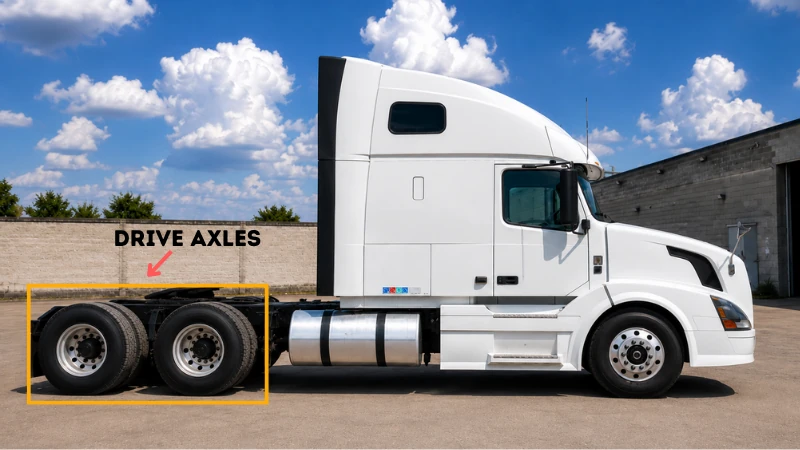
There’s a reason the driven axle sits at the back rather than front. Putting the powered wheels under the heaviest part of the tractor presses them harder into the road, and that extra downforce is what gives a loaded truck the grip it needs to launch and climb. The steer axle stays free to do its own job, pointing the truck, while the rear group handles power and the bulk of the load.
In most cases the drive axle is going to be at the rear of the truck. On plenty of medium-duty and heavy-duty trucks, it’s the rear axle or rear axle group that holds the driven wheels.
| Truck Type | Common Drive Axle Location | Typical Use |
|---|---|---|
| 4×2 truck | One rear drive axle | Local delivery, highway hauling |
| 6×2 truck | One drive axle plus one non-driven rear axle | Freight efficiency, long-haul transport |
| 6×4 truck | Two rear drive axles | Heavy hauling, construction, poor road conditions |
| 8×4 truck | Two drive axles with additional support axles | Dump trucks, mixers, heavy vocational trucks |
Those numbers in a setup like 6×4 are telling you about wheel positions and driven wheel positions. So a 6×4 truck has six wheel positions and four of them driven.
On a Semi Truck or Tractor
Most Class 8 tractors run three axles. One steer axle and two rear drive axles. That rear pair is what people call the tandem drive group. So if you’re asking which axle is the drive axle on a semi truck, the answer is straightforward. It’s the rear tandem on the tractor. On a 6×4 tractor both of those rear axles usually get power, while the trailer axles get none.
What’s Inside a Truck’s Drive Axle?
A truck drive axle contains heavy parts that work under load all day. The differential carrier holds the ring gear, pinion gear, side gears, and bearings that handle torque transfer. Axle shafts carry that torque out to the wheel ends. Spindles, hubs, wheel bearings, and axle seals support rotation and keep gear oil where it belongs.
| Drive Axle Part | Function |
|---|---|
| Axle housing | Holds gears, shafts, bearings, and lubricant |
| Differential | Splits torque between left and right wheels |
| Ring gear | Receives torque from the pinion gear |
| Pinion gear | Transfers driveshaft torque into the differential |
| Axle shafts | Carry torque from the differential to the wheels |
| Wheel bearings | Support rotating wheel ends |
| Seals | Keep lubricant inside and contaminants outside |
| Hubs | Connect wheel assemblies to the axle ends |
Each part has a load-bearing or torque-transfer role. A failure in one component can reduce traction, create noise, leak oil, or stop the truck from moving. Bearings and seals often show early trouble through leaks, heat, play, or noise. A worn spindle can damage the seal and bearing fit. Gear or power divider failure costs more, so early signs deserve a proper check.

Is the Drive Axle the Same as the Rear Axle?
Not necessarily. People use the two terms like they mean the same thing, but a rear axle only becomes a drive axle once it’s actually getting power from the drivetrain. No power, no drive axle. Plenty of trucks carry rear axles that are just there to hold weight and never turn the wheels at all. Depending on where they sit and what they’re doing, you’ll hear these called tag axles, pusher axles, or lift axles.
| Axle Type | Receives Engine Power? | Main Function |
|---|---|---|
| Drive axle | Yes | Moves the truck |
| Steer axle | Usually no | Controls direction |
| Tag axle | No | Supports extra weight behind the drive axle |
| Pusher axle | No | Supports extra weight ahead of the drive axle |
| Lift axle | Usually no | Adds load support when lowered |
So a truck can ride on several rear axles, but the only ones that count as drive axles are the ones putting power to the ground.
What Is the Difference Between a Drive Axle and a Steer Axle?
A drive axle and a steer axle do two completely different jobs. The drive axle powers the truck by taking in torque from the drivetrain. The steer axle isn’t there for power at all. It’s what lets the front wheels turn left or right.
| Feature | Drive Axle | Steer Axle |
|---|---|---|
| Primary role | Transfers power | Controls direction |
| Common location | Rear | Front |
| Receives drivetrain torque | Yes | Usually no |
| Handles heavy traction load | Yes | Limited |
| Uses differential | Usually yes | Not always |
Some all-wheel-drive or off-road trucks can have powered front axles. In that case, the front axle can function as both a steer axle and a drive axle.
Drive Axle vs Lift Axle
We covered tag, pusher, and lift axles in the table above, but the lift axle is worth a second look. It can actually raise up off the road when the truck isn’t loaded heavy enough to need the extra capacity, and some lift axles even self-steer to cut down on tire scrub.
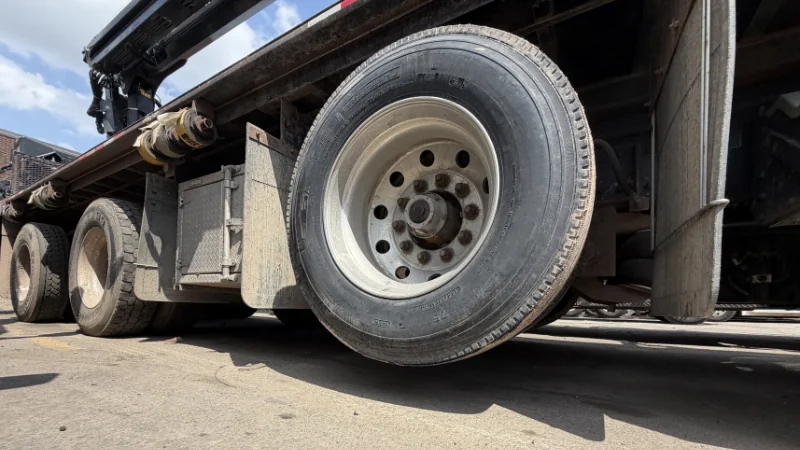
None of that changes the one thing that sets the drive axle apart. It’s the only one delivering power. Suspension style matters here too, whether it’s air ride or walking beam, since that changes how an axle carries its load, but it never changes which axle is doing the driving.
Drive Axle vs Drive Shaft vs CV Axle
People often mix up drive axle, driveshaft, axle shaft, and CV axle. These terms are not the same. A drive axle is the full powered axle assembly. On a heavy truck, that assembly includes the axle housing, differential, axle shafts, hubs, bearings, seals, and wheel ends. A driveshaft is the spinning tube between the transmission and the drive axle. It carries power to the axle, but it does not carry the wheels.
An axle shaft sits inside the axle housing and sends torque out to the wheel end. The CV axle, also known as half shaft, usually refers to a light truck or car with independent suspension. On a 4×4 pickup, a front “drive axle” may mean the CV axle or half shaft. On a heavy commercial truck, this article means the solid powered drive axle under the tractor.
What Is a Tandem Drive Axle?
A tandem drive axle is a paired rear axle setup where both rear axles get power instead of just one. Doubling up like this gives the truck more traction, spreads the load across two axles rather than one, and holds up far better in heavy-duty work.
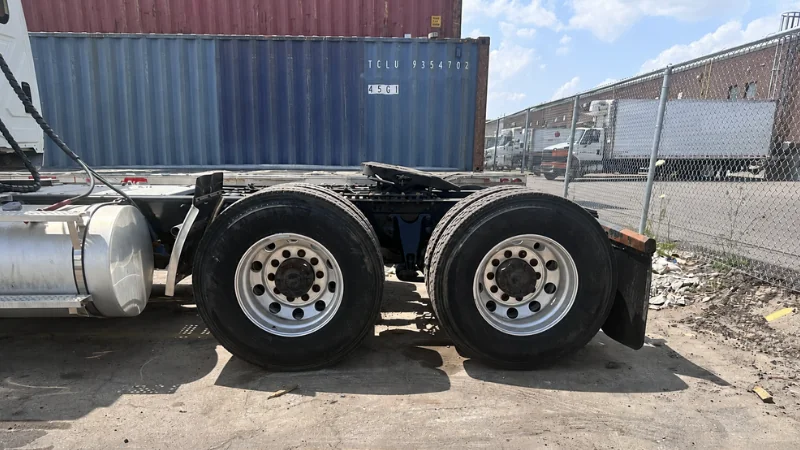
You’ll see tandem drive axles on:
- Semi-trucks that pull heavy trailers.
- Dump trucks that carry dense material.
- Concrete mixers that operate under high payload.
- Logging trucks that travel on rough surfaces.
- Construction trucks that need traction off pavement.
The whole point is that a tandem setup lets the truck lay down more torque without dumping all of it onto a single axle.
Single vs. Tandem Drive Axles (and the Power Divider)
A single drive axle, the kind you’ll find on a lot of 4×2 trucks, keeps the truck lighter and easier on fuel. It does the job nicely for lighter loads, city driving, and regional routes that don’t ask much in the traction department.
A tandem drive, standard on 6×4 tractors, runs two powered rear axles instead. That extra axle buys you more grip and stronger load support, which is exactly what you want for heavy freight, construction work, steep grades, snow, and soft yards.
Here’s the piece most basic guides barely mention. The inter-axle differential, better known as the power divider. On a tandem drive truck, this is the unit that splits torque between the two rear drive axles. It also lets those two axles turn at slightly different speeds during normal driving, and the driver can lock it when conditions get bad to claw back extra traction.
A failing power divider usually shows clear signs like binding, odd noises, a warning light, or a harsh feel in the driveline. It sits inside the tandem drive system, so catching these signs early can be the difference between a quick fix and a full differential rebuild.

Why Do Trucks Need Drive Axles?
A truck only earns its keep when it’s moving freight, and the drive axle is what makes that possible. It’s also the part taking the most punishment while it happens, absorbing the full hit of trailer weight, rough ground, and hard pulls all at once. That’s the trade-off worth understanding.
The same axle that lets a truck haul heavy loads and hold traction on a bad grade is also the one most likely to wear out and park the rig when it’s neglected. A healthy drive axle keeps the truck working. A failing one can shut the whole thing down. Which is exactly why it pays to know the problems that tend to show up.
What Are Common Drive Axle Problems?
Common truck drive axle problems include oil leaks, gear noise, bearing wear, vibration, overheating, and broken axle shafts. These problems usually affect power transfer, lubrication, or wheel-end support.
| Problem | Common Sign | Possible Cause |
|---|---|---|
| Axle oil leak | Wet axle housing or wheel end | Failed seal or gasket |
| Gear whine | High-pitched noise while driving | Worn ring and pinion gears |
| Vibration | Shaking under acceleration | Driveshaft or axle shaft issue |
| Overheating | Hot axle housing | Low lubricant or overload |
| Bearing wear | Grinding or rumbling sound | Damaged wheel bearing |
| Broken axle shaft | Loss of drive to wheel | Shock load or metal fatigue |
These same problems double as your early warning signs. Oil pooling around the differential or wheel ends points to a failing seal. A whine that rises and falls with speed usually means worn ring and pinion gears. A clunk when you shift from drive to reverse, a vibration that builds under load, lost traction on acceleration, or heat coming off the axle housing all deserve a look before they spread.
A drive axle also lives and dies on its lubrication, since low axle oil can quietly destroy gears, bearings, and seals, so checking the oil level is one of the simplest ways to protect the whole assembly. When something does feel off, a mechanic typically checks the lubricant level, gear wear, bearing condition, backlash, seals, and wheel-end play.
Can a Truck Move Without a Working Drive Axle?
A truck cannot move under its own power if its only drive axle fails completely. The engine may run, but torque cannot reach the wheels.
Some multi-axle trucks may still move if another drive axle remains functional, depending on drivetrain design and damage location. Severe axle damage usually requires towing or repair before safe operation.

Why Drive Axle Maintenance Matters
The drive axle quietly does more than almost any other part on a heavy truck. It takes the engine’s power and turns it into motion while carrying a huge share of the load, and it never gets a break from either job.
All that constant stress is why it slowly wears down, and why a truck that skips axle maintenance is usually one that ends up broken down at the worst possible time. Keeping the gear oil fresh, the seals dry, and the bearings sound is simple, inexpensive insurance against a failure that can take the whole truck out of service.

Frequently Asked Questions
The drive axles are the rear axle group on the tractor, directly behind the cab. On most Class 8 tractors, that means the tandem pair behind the steer axle. The front steer axle and trailer axles are not powered.
The driveshaft is the spinning tube that carries power between the transmission and drive axle. The drive axle applies that power to the wheels through the differential and axle shafts. One delivers the power; the other uses it.
Common signs include clunking or whining under power, vibration that changes with speed, gear oil leaks at the differential or axle seals, uneven tire wear, and heat near the hub. Have the axle checked before noise turns into a breakdown.
It depends on the configuration. A 4×2 has one drive axle. A 6×4, the common heavy-duty tractor setup, has two drive axles. The first number shows total wheel positions, and the second number shows driven wheel positions.
Briefly, and with risk. A leaking seal or worn bearing may let you reach a shop, but a failing differential, power divider, or axle shaft can seize, break, or strand the truck. Diagnose drive axle noise quickly.